

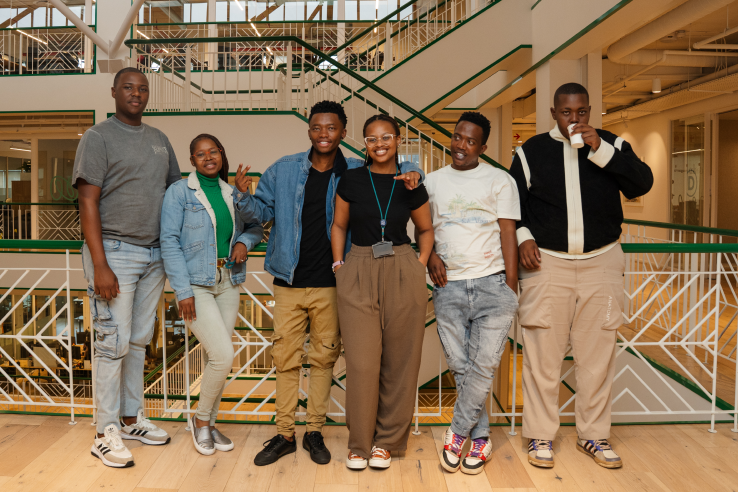

The True Catalyst for Global Social Impact
By Talent Match Africa (Featuring Insights from Gerard Holland, Founder & Marco Miranda CEO
“Talent is distributed evenly, opportunity is not.”.
This quote, originally introduced to TMA Founder Gerard Holland by Jataka Eady, forms the philosophical backbone of Talent Match Africa. By 2050, roughly a third of the world’s population will live in Africa, with an average age of 19. The continent is producing millions of highly capable university graduates who simply lack the geographic proximity to Western corporate headquarters.
While connecting this talent to global businesses naturally results in incredible social impact, Holland emphasizes a hard truth that many purpose-driven leaders miss: You cannot have a lasting social impact without having a massive business impact first.
The Foundation of Business Fundamentals “I’ve met a lot of impact business CEOs and founders, and something that’s become glaringly obvious to me is that you have to have the business fundamentals first, or you actually can’t have impact,” Holland explains.
If TMA only offered businesses a “feel-good” story without delivering top-tier software developers, financial analysts, and digital marketers, the model would fail. The primary mandate is to provide clients with exceptional quality, enabling those businesses to grow top-line revenue, increase efficiency, and run faster.
The Ripple Effect When Western businesses win, the social impact in Africa follows by default. Holland describes this as the “ripple effect.” For every person placed into a high-earning role with an international client, the economic benefits flow directly to their families and communities. This leverage is particularly high for female professionals; data shows that for every female put into a job in Africa, she supports up to six other people.
Furthermore, creating these roles inspires the next generation. When young people see their older siblings securing professional careers with companies in New York, London, or Sydney, it reinforces the value of education and hard work.
Ultimately, hiring from Africa isn’t an act of charity—it is a strategic business decision. By prioritizing quality, businesses can build their global capacity while organically driving one of the greatest economic empowerments of our time.
The Evolution of Global Talent: Why Integrated Remote Teams are Replacing Traditional Offshoring
For decades, Western companies relied on a traditional offshoring playbook, primarily looking to Asia-Pacific regions like India and the Philippines to cut operational costs. However, as the digital economy demands greater agility, specialized skills, and seamless collaboration, this outdated model is breaking down. Today’s most successful organizations are abandoning traditional offshoring in favor of building highly skilled, fully integrated global remote teams.
Here is why the “remote team” model—particularly thriving in emerging talent hubs like Africa—is vastly superior to the traditional offshore approach.
The Pitfalls of Traditional Offshoring
Traditional offshoring was built on a “bums on seats” mentality, where businesses focused almost exclusively on finding the cheapest labor possible. This approach has created several distinct disadvantages:
- Process-Bound Script Followers: In traditional offshore hubs, workers are often trained to be rigidly compliant and process-driven. If a designated process requires steps A to E, and step C breaks, traditional offshore workers will typically stop working and wait for instructions rather than innovating a solution.
- Market Saturation and High Turnover: Markets like India and the Philippines are now heavily saturated, resulting in fierce competition for talent, rapid wage inflation, and incredibly high turnover rates—with up to 60% of workers in India likely to change employers within 12 months.
- Communication Delays: Asia-Pacific destinations typically present a 9 to 12-hour time zone gap for US and European companies. This creates a disjointed workflow where an email sent during the day isn’t answered until the next day, resulting in 24-hour communication delays that stall business momentum.
- The Work-From-Home Infrastructure Risk: Post-COVID, many traditional offshore markets shifted to full work-from-home models. In emerging economies, this often leads to a disastrous lack of business continuity due to unreliable internet connections and unstable residential power supplies.
The Remote Team Advantage
In contrast, building a global remote team is not about chasing the lowest hourly rate; it is about accessing premium, untapped global talent to accelerate business growth. Organizations partnering with strategic workforce providers like Talent Match Africa (TMA) are discovering the massive advantages of the remote team framework.
- The “Team Within a Team” Culture A true remote team is not treated as an external vendor or a group of faceless gig workers. Instead, they are treated as absolute normal team members who simply happen to sit in an office in Nairobi, Cape Town, or Johannesburg rather than Boston or Sydney. These professionals represent their client’s brand directly, understand the company culture, and participate fully in the organization’s mission.
- Critical Thinkers and Problem Solvers Unlike traditional offshore script-followers, the modern remote workforce in Africa is characterized by natural entrepreneurs and critical thinkers. These highly university-educated professionals challenge the norm. If a process breaks, they will proactively suggest a better route—asking, “Why don’t we just do G and H?” instead of waiting for permission to fix steps A through E.
- Enterprise-Grade, Office-Based Environments To combat the isolation and infrastructure risks of offshore work-from-home models, premium remote teams operate from state-of-the-art corporate offices. This ensures that talent has access to enterprise-grade fiber internet and uninterrupted backup power supplies (UPS). Furthermore, working in a shared office space provides camaraderie, energy, and access to on-site career coaches, fostering a professional environment that residential work simply cannot match.
- The “Camera-On” Mandate One of the most defining features of a successful remote team is high engagement. Providers like TMA enforce a strict “camera on” culture. By refusing to tolerate faceless interactions, remote team members build genuine, face-to-face relationships with their colleagues abroad, complete with banter, a shared sense of humor, and high emotional intelligence.
- Real-Time Collaboration in the “Goldilocks” Time Zone Remote teams function best when they can actively collaborate with headquarters. African markets provide a strategic time zone advantage, sitting straight up-and-down with Europe and the UK, and just 5 to 8 hours ahead of the US East Coast. This ensures 6+ hours of daily overlap with American teams, allowing for real-time collaboration and same-day problem resolution that completely eliminates the traditional offshore communication lag.
Conclusion
The era of racing to the bottom for cheap, disconnected offshore labor is over. By transitioning to a premium remote team model, businesses are unlocking access to highly skilled, university-educated professionals who act as true extensions of their local workforce. The result is a more resilient, innovative, and deeply integrated global organization capable of running faster and scaling more efficiently than ever before.
Build a High-Impact Team That Delivers Real Business Results
If you’re rethinking traditional offshoring and exploring a more integrated approach to global talent, Talent Match Africa helps businesses hire high-performing remote professionals from Africa.
From finance and operations to marketing, customer support, and software developers, we connect companies with university-educated professionals who work as a true extension of their team, not an outsourced vendor.
The result is stronger performance, real-time collaboration, and a hiring model that creates lasting economic opportunity while helping your business scale faster.
Book a free consultation to see what an integrated African remote team could look like inside your business.